
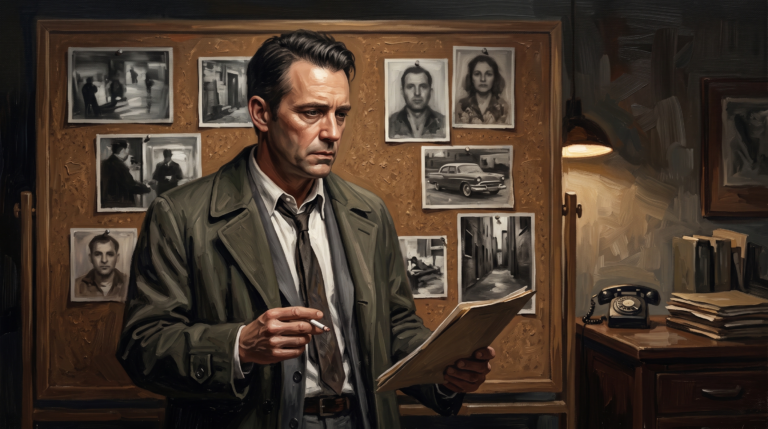
Television has convinced us that criminal profilers can glance at a crime scene and instantly reconstruct an offender’s personality, habits, and life story. Reality is considerably less dramatic, but far more interesting.
Criminal profiling is neither mind reading nor investigative magic. it’s the systematic analysis of behavior, forensic evidence, psychology, and criminology to develop evidence-based hypotheses about an unknown offender. The key word is hypotheses! A criminal profile is not evidence, nor can it identify a suspect with certainty. Instead, it helps investigators organize information, prioritize leads, and understand the behavioral patterns that emerge from a crime.
Ironically, one of the greatest dangers in criminal profiling is not the offender but the investigator.
Confirmation bias occurs when investigators become attached to an initial theory and begin interpreting new evidence in ways that support their existing beliefs while overlooking contradictory information. Once a compelling profile has been developed, there is a natural temptation to view every new clue through that lens.
Modern investigative practices emphasize structured analytical methods and multidisciplinary collaboration precisely because they reduce the influence of these cognitive biases. A good investigator looks for evidence that supports a theory. A great investigator actively searches for evidence that disproves it.
How Criminal Profiling Began
Although many people associate criminal profiling with the FBI, the practice predates the agency by decades. One of the earliest documented behavioral assessments was written in 1888 by physician Dr. Thomas Bond during the Jack the Ripper investigation. By examining the victims’ injuries, Bond attempted to infer characteristics about the unknown offender, laying the groundwork for what would later become behavioral analysis.
The field gained widespread recognition during the 1970s, when the FBI’s Behavioral Science Unit interviewed incarcerated serial offenders to identify recurring behavioral patterns. Researchers including John Douglas, Robert Ressler, Roy Hazelwood, and Ann Burgess helped formalize many investigative techniques that continue to influence law enforcement today. However, as the discipline matured, many of its early assumptions were tested against scientific research, and not all of them survived.
From Personality Labels to Behavioral Evidence
One of the best-known concepts in criminal profiling is the distinction between organized and disorganized offenders. According to early FBI theory, organized offenders carefully planned their crimes, while disorganized offenders acted impulsively and left chaotic crime scenes.
The model proved useful for teaching investigators, but scientific studies have found little evidence that offenders consistently fit into one category or the other. Human behavior is considerably more complex. An offender may meticulously plan one aspect of a crime while behaving impulsively during another. As a result, modern investigative psychology places much less emphasis on personality labels and instead focuses on observable behavior supported by evidence.
Every crime represents a series of decisions. Why was a particular location chosen? Why was one method used instead of another? Which actions appear deliberate, and which resulted from unexpected circumstances? These questions are often more informative than attempting to assign psychological labels to an unknown offender.
Modus Operandi and Signature Behavior
One of the most important distinctions in behavioral analysis is the difference between a criminal’s modus operandi and their signature behavior.
A modus operandi, or MO, refers to the practical methods used to successfully commit a crime. It includes behaviors that help offenders avoid detection, gain access to victims, or accomplish their objective. Because criminals learn from experience, their MO often changes over time.
Signature behavior serves a different purpose. These actions are not necessary to complete the crime but instead satisfy psychological or emotional needs unique to the offender. While signature behavior tends to be more consistent than an MO, researchers caution that it can also evolve as offenders gain experience or adapt to changing circumstances.
Understanding this distinction helps investigators determine which aspects of a crime reflect practical decision-making and which may reveal deeper behavioral motivations.
Cyberprofiling: When Criminal Profiling Meets Cybersecurity
Cyberprofiling applies the principles of criminal profiling to cybercrime investigations. Rather than examining footprints, bloodstains, or witness statements, investigators analyze digital artifacts and behavioral indicators left behind by threat actors.
Cybercriminals expose behavioral patterns through malware development, infrastructure reuse, operational security mistakes, communication styles, cryptocurrency transactions, and attack timing. Threat intelligence analysts routinely examine these characteristics to identify relationships between campaigns, attribute attacks to known threat actors, and anticipate future operations.
Although the technology has changed, the investigative philosophy remains remarkably similar. Whether examining a homicide scene or a ransomware campaign, investigators are ultimately studying human decision-making.
What Does the Science Say?
Perhaps the most important question surrounding criminal profiling is whether it actually works.
The answer is more nuanced than popular culture suggests. Research indicates that behavioral analysis can be valuable when combined with forensic science, psychology, and traditional investigative techniques. It can help generate investigative hypotheses, identify behavioral patterns, and provide context for complex cases.
However, systematic reviews have also found limited empirical support for many traditional profiling methods, particularly those based on intuition or rigid offender classifications. Modern forensic psychology therefore favors evidence-based behavioral analysis over dramatic personality predictions. In other words, profiling works best when investigators remain grounded in observable evidence rather than speculation.
Despite its popularity in books and television, criminal profiling is not a shortcut to solving crimes. It’s a tool. A disciplined analytical process that embraces probability instead of certainty. In modern investigations, that distinction is precisely what makes it valuable.