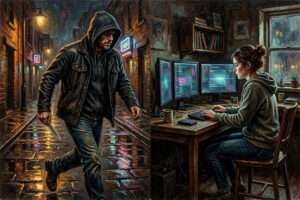

When people hear the word “forensics,” they usually imagine crime scenes, fingerprint powder, or somebody in sunglasses dramatically removing their gloves before announcing the victim died “between 8:13 and 8:17 PM.”
But not all investigations happen in dark alleys or server rooms. Some happen inside churches, monasteries, archives, and religious institutions. That’s where ecclesiastical forensics comes into play.
Ecclesiastical forensics is a niche but fascinating field involving investigative methods applied to religious contexts. It combines elements of history, law, psychology, document analysis, digital investigations, and institutional inquiry. In simple terms: it’s the art of investigating matters connected to religious organizations and clergy.
And yes, it sounds exactly like something from a medieval detective series.
What’s Ecclesiastical Forensics?
The term “ecclesiastical” refers to matters related to the Church or religious institutions. Ecclesiastical forensics focuses on investigating issues that arise within these organizations, whether they involve misconduct, fraud, historical authenticity, abuse allegations, document verification, or internal disciplinary matters.
Unlike traditional criminal investigations, ecclesiastical investigations often involve a mixture of religious law (canon law, for example), internal church procedures, civil law, ethical and theological considerations.
This creates a unique environment where investigators may need to understand both legal evidence and religious structures. In other words, sometimes you need to know how metadata works and how a diocesan hierarchy functions.
Faith, Authority, and Investigations
An ecclesiastical investigator may work alongside church tribunals or legal authorities to determine whether religious laws were violated. Think of it as an internal compliance investigation, except the organization has existed for nearly two thousand years and occasionally stores records older than some countries.
Ecclesiastical investigations may also overlap with cases involving extremist religious movements, coercive groups, or cult-like organizations. In these situations, investigators often analyze patterns of manipulation, charismatic authority, psychological dependency, and abuse of power. The focus is not necessarily theology itself, but rather how belief systems can be exploited to control followers or justify criminal behavior.
Cases involving cult leaders frequently attract the attention of behavioral analysts and criminal profilers because of the strong influence these individuals can have over group members. One of the most infamous examples is Charles Manson, whose manipulation of followers became a notorious example of psychological control and ideological influence leading to violent crimes.
Although cult investigations are not technically governed by canon law in most cases, ecclesiastical forensics may still intersect with these scenarios when religious authority structures, spiritual abuse, or institutional dynamics become relevant to an investigation. In other words, investigators sometimes need to determine where sincere belief ends and manipulation begins, which is often far more complicated than movies make it look.
Investigating Religious Misconduct
One of the most sensitive and controversial areas of ecclesiastical forensics involves investigating misconduct within religious institutions. These cases can range from financial fraud and corruption to psychological abuse, coercive control, and serious criminal offenses committed by individuals in positions of religious authority.
Because religious leaders are often viewed as trusted figures, these investigations tend to be emotionally complex and institutionally delicate. Investigators are not only dealing with evidence and legal procedures, but also with communities, belief systems, reputations, and, in many cases, victims who may have spent years afraid to speak publicly.
One of the most widely known examples is the clergy abuse investigations involving members of the Catholic Church. Over the years, investigations across several countries uncovered patterns of abuse allegations, institutional concealment, document handling issues, and failures in reporting misconduct to civil authorities. These cases demonstrated how ecclesiastical investigations often require cooperation between church tribunals, law enforcement agencies, psychologists, and forensic specialists.
Another major example is the case surrounding Jim Jones and the Peoples Temple. Jones used religious authority, psychological manipulation, and social isolation to control followers, ultimately leading to the mass murder-suicide tragedy in Jonestown in 1978. Investigators and behavioral analysts later examined how charismatic leadership, dependency, and ideological control contributed to the event.
Modern ecclesiastical investigations are also increasingly connected to digital forensics. Investigators may analyze emails, archived communications, financial transactions, cloud storage, deleted files, and social media activity to establish timelines, identify concealment attempts, or verify testimonies. In many cases, the investigation no longer ends at physical archives or witness interviews. It also involves metadata, devices, and digital evidence.
This is what makes ecclesiastical forensics such a multidisciplinary field. A single investigation may combine interview techniques, victimology, behavioral analysis, financial tracing, legal review, and cybersecurity expertise all at once. Basically, it’s part criminal investigation, part institutional audit, and part psychological puzzle, with significantly more paperwork than most crime shows are willing to admit.
Challenges of Ecclesiastical Investigations
One of the biggest challenges is restricted access to information. Religious institutions may keep internal records confidential, cite doctrinal protections, or rely on hierarchical approval before releasing documents. On top of that, investigators often face jurisdictional complexity, especially when cases cross international borders or involve decentralized religious structures. Add emotional pressure from communities and the reputational weight of religious leadership, and you get investigations that are as politically sensitive as they are evidentially complex.
Another difficulty is delayed reporting and fragmented evidence. Victims may take years or even decades to come forward, meaning physical evidence is gone, memories have faded, and key individuals may no longer be reachable. In many cases, investigators must reconstruct events from partial testimonies, archived documents, or indirect digital traces.
A major example of investigative complexity can be seen in the tragedy involving the Heaven’s Gate. This group became widely known after the 1997 mass death of its members in California, led by Marshall Applewhite.
One of the biggest challenges in understanding and investigating this case was the extreme level of isolation and ideological control within the group. Members had voluntarily withdrawn from broader society, changed identities, and cut off external communication, which made it difficult for investigators to reconstruct internal dynamics in real time.
After the incident, much of the analysis relied on digital evidence, video recordings, and personal materials left behind, rather than traditional witness testimony. This created a unique forensic scenario where investigators had to interpret highly curated internal communications and belief-driven documentation rather than conflicting external accounts.
Another illustrative case involves the investigations into the Church of Scientology. Over the years, multiple legal disputes, testimonies, and investigative reports have raised questions about internal disciplinary practices, financial structures, and member treatment.
For investigation enthusiasts, it’s a reminder that forensic work extends far beyond traditional crime scenes. Sometimes the evidence is hidden in encrypted devices. Sometimes it’s hidden in archives older than modern civilization. And sometimes both are true at the same time.